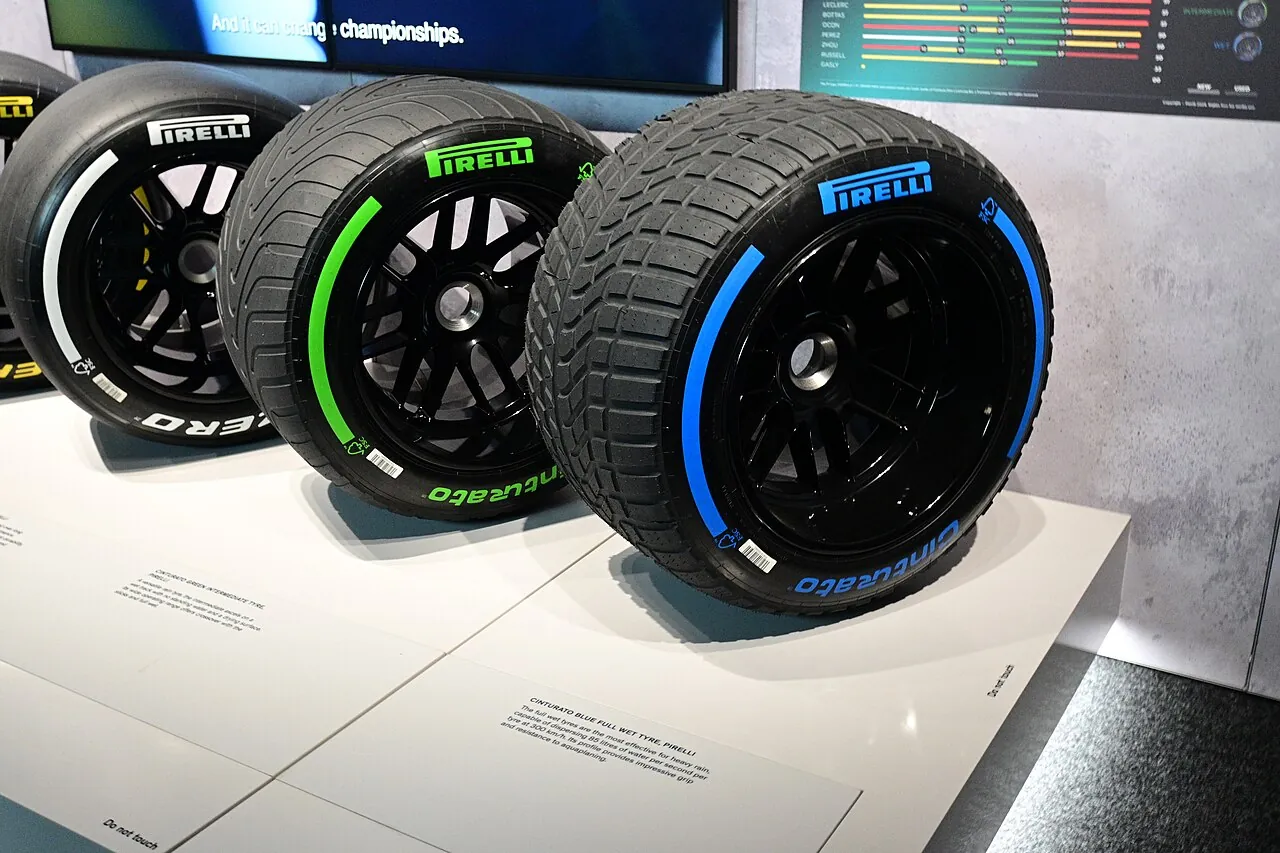
Pirelli has confirmed that its 2027 intermediate tyre will be designed to address the warm-up problems that drivers have complained about this season. Speaking to The Race, Pirelli’s motorsport director Dario Marrafuschi said the company had been working on a different specification for next year, with the focus on how the tyre reaches its operating temperature.
The comments, reported this week, follow a wet São Paulo Grand Prix in which F1’s rain tyres came under renewed scrutiny.
The warm-up problem
“Some of the drivers were complaining about warm-up, so we have been working for next year on the warm-up phase, on the intermediates,” Marrafuschi said.
He declined to go into detail about the changes planned for 2027, and Pirelli has not published the specification of the new tyre. Marrafuschi also made clear that the development work does not mean Pirelli regards this year’s wet-weather tyres as a failure.
Reports have linked the issue to the demands of the 2026 technical rules. To cope with the loads generated by the new cars, the tyres were given a more robust construction and run at higher minimum pressures, which has made them stiffer and harder to bring up to temperature, particularly in cool and wet conditions.
Testing programme
Pirelli has already carried out wet-weather running with prototype tyres. Last month, Mercedes reserve driver Frederik Vesti tried several new intermediates with different compounds and constructions during a test at Magny-Cours, where the track is artificially soaked to provide controlled, repeatable conditions.
Reports differ on how much of what Pirelli learned at Interlagos can be applied to next year’s tyres, given the timing of the homologation process for the 2027 wet-weather range.
Drivers want better rain tyres
Wet-weather tyres have long been a sore point in F1. Drivers have often criticised the full wet tyre for producing too much spray and offering too little advantage over the intermediate, meaning it is rarely used. In 2026, the focus has shifted to the intermediate, with drivers struggling to generate temperature and grip in the early laps of a stint.
Lando Norris, who won in São Paulo, has said he hopes to see much-improved rain tyres in 2027. The Brazilian race, held in changing conditions, exposed how sensitive the current cars are to tyre temperature, with Liam Lawson among those reporting graining on the intermediates.
What it means
For the rest of 2026, nothing will change: teams will continue with the current wet-weather range for Las Vegas, Qatar and Abu Dhabi. Rain is rare at those venues, though cold night-time temperatures in Las Vegas will again test how quickly tyres warm up.
For next season, a quicker warming intermediate could make a significant difference to safety and racing in mixed conditions, reducing the risk of drivers being caught out on cold tyres after a pit stop or a safety car restart. Pirelli will be hoping its revised design wins over the drivers when it makes its race debut in 2027.
Featured image: Photo: Hullian111 / Wikimedia Commons, CC BY-SA 4.0